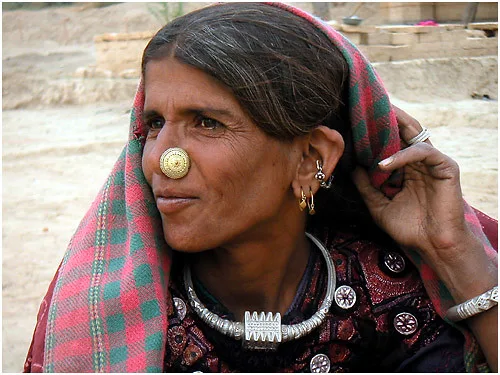
Walk into any old bazaar lane in Jaipur and you'll hear it before you see it: the soft tap-tap of a silversmith's hammer against a half-formed bangle. Rajasthani silver jewelry is not just an accessory category, it is a living archive of the state's history, its tribal communities, its royal courts, and the trade routes that once connected this desert kingdom to the wider world. Whether you're a first-time visitor to the Pink City, an expat hunting for meaningful gifts, or a collector building a serious wardrobe of South Asian craft, understanding this tradition before you buy will serve you well.
India is now the world's fastest-growing silver jewelry market. According to GJEPC's 2024 survey, India leads global silver jewellery gains, outpacing other major markets in both volume and export value. Rajasthan sits at the heart of that story.
A Craft Rooted in Centuries of Royal Patronage
The history of Rajasthani jewelry making stretches back well over five centuries. Under Rajput rulers and later the Mughal-influenced courts of the 16th and 17th centuries, jewelry became a language of power, identity, and divine connection. Silversmiths, known locally as sunars or sarafs, held privileged positions in royal households, crafting pieces not only for queens and nobles but for temple deities and ceremonial horses.
The craft flourished particularly in Jaipur after Maharaja Sawai Jai Singh II founded the city in 1727. His deliberate policy of inviting artisan communities to settle in specific bazaars (a tradition you can still trace on a Jaipur heritage walk) created clusters of specialised knowledge that passed from father to son, generation after generation. The Johari Bazaar and Tripolia Bazaar areas remain centres of the silver trade today.
What drove the preference for silver over gold in everyday Rajasthani life? Partly religion: silver is associated with the moon, with purity, and with goddesses like Lakshmi. Partly practicality: in a hot, arid climate, silver stays cooler against skin than gold. And partly economics: silver was accessible to pastoral and farming communities in ways that gold was not, which is why the craft developed across all social strata rather than remaining an elite preserve.
To understand how deeply jewelry weaves into Jaipur's cultural DNA, it helps to read a bit about the history of Jaipur itself, where commerce, art, and court politics shaped each other for three centuries.
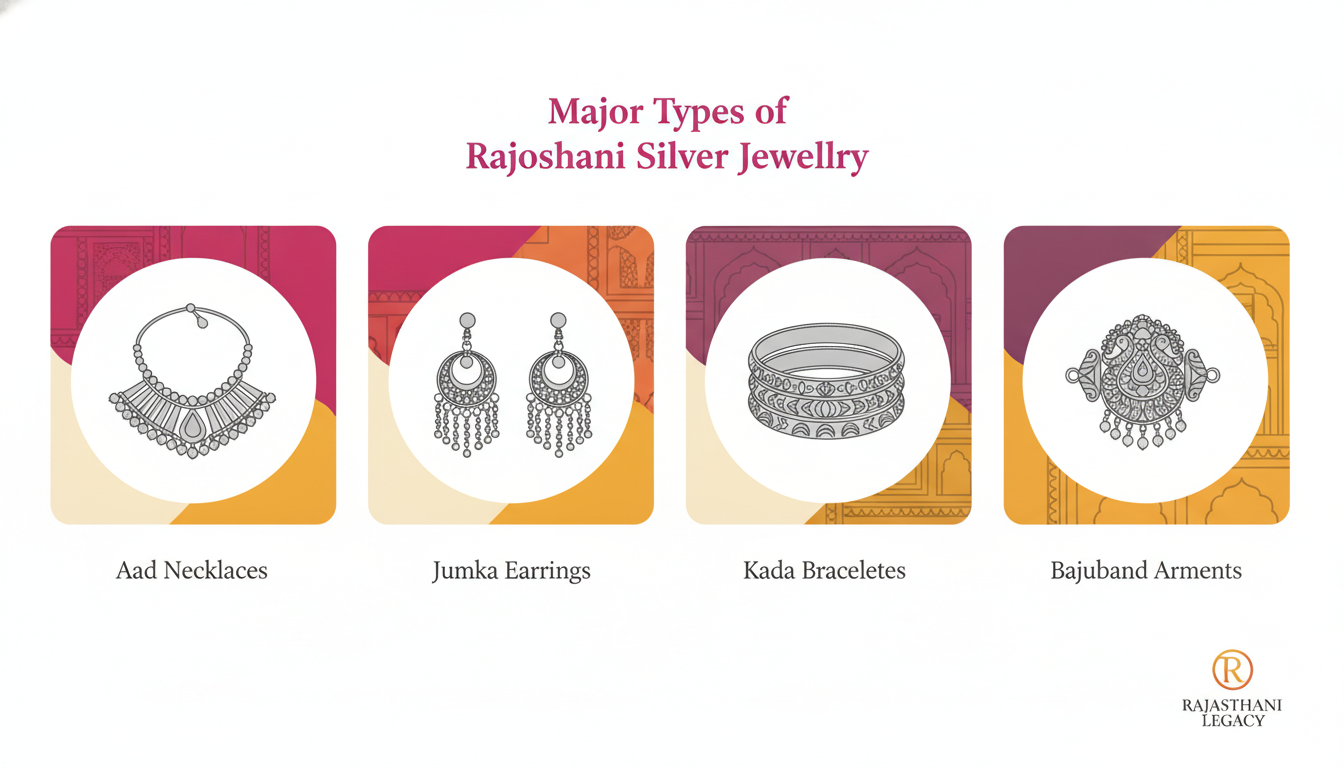
The Major Types of Rajasthani Silver Jewelry You Should Know
One of the most common mistakes buyers make is treating all silver jewelry from this region as a single category. It is not. Distinct forms carry distinct meanings, techniques, and community associations. Here is a practical map:
| Jewelry Type | Description | Typical Wearer / Occasion |
|---|---|---|
| Hasli | Rigid torque-style neckpiece, often embossed or set with stones | Brides, married women; festival wear |
| Payal / Anklet | Articulated ankle chains with bells (ghungroo) | Women across all communities; daily and ceremonial |
| Bajuband | Upper-arm band, broad and engraved | Bridal; classical dance costumes |
| Jhumka | Bell-shaped drop earrings with granulation work | Daily wear to weddings; most widely exported style |
| Tagdi / Waistband | Large, linked silver belt worn over the saree or lehenga | Brides; folk performers |
| Nath | Nose ring, ranging from a small stud to an elaborate hoop | Married women; brides |
| Borla / Matha Patti | Forehead ornament dangling over the centre parting | Rajput and Marwari brides |
| Kara / Bangle | Heavy, plain or carved bangles | Daily wear; gifted at birth and marriage |
| Toe Rings (Bichhiya) | Worn in pairs; signal married status in many communities | Married Hindu women |
This is not an exhaustive list. Regional sub-styles shift from district to district: a Jodhpur silversmith's Hasli will look noticeably different from one made in Udaipur, even if both use the same technique.
What Makes Traditional Rajasthani Silver Designs Distinctive?
The answer is technique, not just aesthetics. Several craft techniques give Rajasthani pieces their characteristic texture and depth, and recognising them makes you a much better shopper.
Meenakari (Enamel Work)
Jaipur's meenakari tradition involves fusing powdered glass colours into engraved silver channels and firing them at high temperature. The result is vivid, stained-glass-like inlay. On silver rather than gold, meenakari tends toward deeper jewel tones: cobalt, crimson, forest green. Jaipur meenakari earned a Geographical Indication (GI) tag from the Indian government, which confirms its regional authenticity.
Kundan Setting
Kundan technically refers to a gold-foil setting technique, but in Rajasthan it is commonly applied on silver bases too, particularly for bridal pieces where high-carat gold is cost-prohibitive. Uncut stones, polki diamonds, rubies, and emeralds, are set into a silver frame using refined gold foil as the adhesive layer.
Granulation and Filigree
Granulation involves fusing tiny silver spheres to a base without visible solder, creating textured surfaces that catch light like finely woven fabric. Filigree (called tarkashi locally) uses drawn silver wire twisted into floral or geometric lattice patterns. Both techniques demand extraordinary patience: a single pair of filigree jhumkas can take an artisan two or three days to complete.
Oxidised Finish
Oxidised silver, intentionally darkened through a chemical patina process, has become one of the most popular export styles from Jaipur in the last decade. It highlights engraved motifs by creating contrast between recessed dark areas and polished high points. This finish requires specific care (more on that below).
Research into the broader Jaipur handicrafts sector shows that these techniques sit within a much larger ecosystem of craft knowledge, interconnected with block printing, blue pottery, and gemstone cutting.
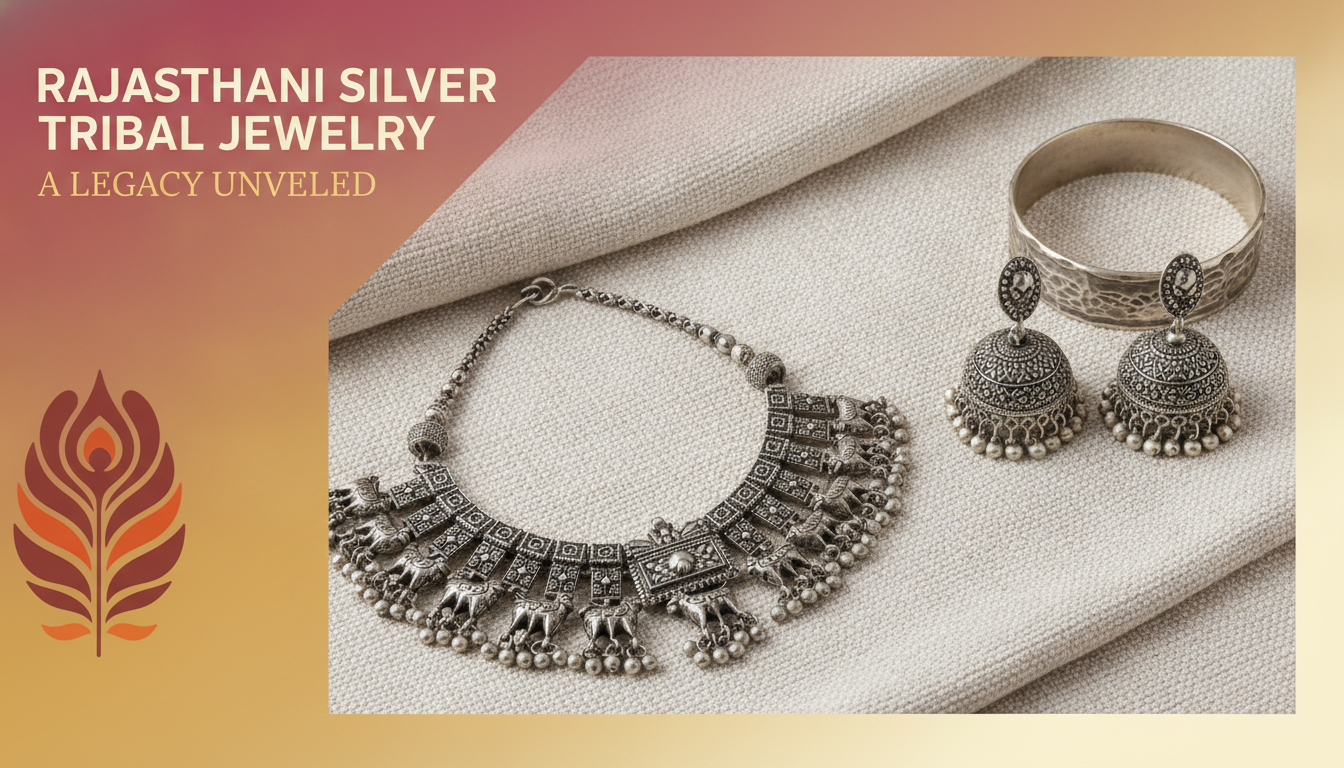
Silver Tribal Jewelry from Rajasthan: The Category That Deserves More Attention
Most buyers focus on the court-influenced, intricate styles that fill Johari Bazaar's shop windows. But silver tribal jewelry from Rajasthan represents an entirely separate and arguably more ancient lineage, one that many curated collections overlook entirely.
Communities like the Rabari, Bhil, Meghwal, and Lohar groups created large, bold, heavily weighted ornaments that served social and spiritual functions beyond decoration. A Rabari woman's dowry silver could represent years of accumulated family wealth. Pieces were often stamped rather than filigree-worked, with geometric motifs: spirals, sun wheels, and abstracted animal forms.
Tribal silver tends to be heavier, less refined in surface finish, and more architecturally dramatic than courtly styles. The large challa rings worn on thumbs, the stacked dhagla necklaces layering multiple strands, and the massive ghungroo-laden payal sets are all forms rooted in pastoral Rajasthan rather than palace corridors.
Authentic antique tribal pieces are increasingly rare and often surface through auctions. For context, Jaipur has seen noteworthy jewelry auctions that give a sense of how even seized or reclaimed silver ornaments carry significant heritage value. Contemporary artisans are reviving tribal design vocabularies in new forms, and these make excellent collector purchases.
How to Identify Real Silver Jewelry from Rajasthan
This is the question that trips up most first-time buyers, and the stakes are real. Silver-plated brass pieces flood tourist markets at silver prices. Here is what to check:
1. Look for the BIS Hallmark. Since 2021, hallmarking of silver in India under the Bureau of Indian Standards is mandatory for registered jewelers. Authentic 925 sterling silver (92.5% pure) will carry a six-digit HUID (Hallmark Unique Identification) code along with the BIS logo, purity mark (925), assayer's mark, and year of marking. Examine pieces under good light with a magnifying glass if needed.
2. The magnet test. Silver is non-magnetic. If a piece is attracted to a strong magnet, it contains significant ferrous metal content and is not pure silver. This test does not catch silver-plated copper or brass, but it eliminates the worst fakes.
3. The ice test. Silver has exceptionally high thermal conductivity. Place an ice cube on a flat silver surface: it should melt noticeably faster than it would on glass or plastic. It is not precise enough to distinguish silver from silver-plated copper, but it confirms you are not holding plastic or resin.
4. The rub test. Rub the piece firmly with a white cloth. Black oxidation marks on the cloth suggest real silver reacting with air. No mark at all may indicate plating or coating.
5. Ask for a certificate or receipt with purity stated. Any reputable dealer will provide documentation. If a seller refuses or deflects, treat that as a red flag.
The Silver Institute's industry report notes that consumer demand for certified, hallmarked silver has risen sharply globally, driven by buyers who've learned the hard way about plated substitutes. In India's context, that shift is accelerating.
Where to Buy Rajasthani Silver Jewelry in Jaipur in 2026
Jaipur's silver jewelry market is more stratified than it appears. Three distinct tiers exist:
The wholesale-to-retail bazaars: Johari Bazaar, Tripolia Bazaar, and Bapu Bazaar are the traditional hubs. Prices here can be competitive but quality varies enormously. Bargaining is expected, and it helps to know the silver spot price on the day you are buying (check the MCX rate on your phone).
Fixed-price heritage stores and showrooms: Several multi-generational family businesses along M.I. Road and near Hawa Mahal operate on fixed or near-fixed pricing with proper hallmarking. The markup is higher than bazaar prices, but you're paying for certification, return policies, and confidence.
Online curated platforms: For expats, tourists who've returned home, or international buyers, authentic Rajasthani silver jewelry online from curated Indian platforms has become the safest route to genuine pieces. Reputable platforms photograph hallmarks, provide certificates, and offer return windows.
The global silver jewelry market is projected to grow steadily through 2030, according to TechSci Research, with Indian artisan silver cited as a key driver of the premium segment. And Markets and Data's India Jewelry Market report projects the Indian jewelry market to expand substantially through 2031, with silver gaining share as younger buyers move away from heavy gold investments toward lighter, more wearable craft jewelry.
For visitors who want a structured introduction to the city's craft landscape before shopping independently, a guided walk through Jaipur's heritage quarters is genuinely useful. The physical experience of watching silversmiths work before you buy from them changes how you evaluate pieces.
Caring for Your Rajasthani Silver Ornaments
Silver tarnishes. That is not a flaw; it is chemistry. Silver reacts with sulphur compounds in air and on skin to form silver sulphide, the dark layer known as tarnish. The good news: tarnish is reversible, and with basic care, your pieces will last generations.
Storing silver correctly: Store pieces individually in anti-tarnish pouches or cloth bags. Keep them away from rubber bands (rubber accelerates tarnishing), direct sunlight, and humid environments. A silica gel sachet in your jewelry box slows moisture-related tarnish significantly.
Cleaning oxidised pieces carefully: Here is the distinction most people miss. Oxidised Rajasthani silver jewelry is intentionally darkened, and aggressive polishing will remove the patina that makes the design legible. Clean oxidised pieces with only a soft, dry cloth. Never use silver polish dips, ultrasonic cleaners, or toothpaste on them.
Cleaning non-oxidised silver: A paste of baking soda and water, applied with a soft toothbrush and rinsed thoroughly, works well for lightly tarnished pieces. Commercial silver polishing cloths are safe for flat surfaces. For intricate filigree, rinse in warm water with a drop of mild dish soap, then pat dry completely before storing.
When to see a silversmith: If stones are loose, clasps are bending, or filigree threads are separating, take the piece to a silversmith rather than attempting DIY repairs. Jaipur's karigars can often restore heavily damaged pieces to near-original condition for a fraction of what the piece is worth.
A 2020 Silver Institute report noted that with proper care, sterling silver jewelry maintains its structural integrity and value over decades, which is part of what makes it a sound purchase whether for personal wear or as a gift.
An Original Framework for Buying: The Three-Layer Test
Here is something competitor guides rarely offer: a practical mental framework for evaluating any piece of Rajasthani silver jewelry before you pay.
Layer 1: The Material. Is it real silver? Check the hallmark, run the magnet test, ask for documentation. This is non-negotiable.
Layer 2: The Craft. Is the technique actually hand-done or machine-stamped? Look at the reverse of the piece. Hand-engraved work shows slight irregularities; machine-stamped work is perfectly symmetrical to a degree that handwork cannot achieve. Neither is necessarily bad, but you should know what you are paying for. Hand-crafted pieces command, and deserve, a premium.
Layer 3: The Provenance Story. Does the seller know who made it, from which community, using which technique? Authentic pieces come with knowledge attached. A seller who can tell you the piece uses Jodhpur-style granulation, made by a karigar from a specific neighbourhood, is selling you something real. A seller who cannot tell you anything beyond "it is traditional" is a risk.
This three-layer check takes three minutes and separates genuinely informed buyers from tourists who end up disappointed later.
Key Takeaways
- Rajasthani silver jewelry spans court traditions, tribal lineages, and regional sub-styles, these are not interchangeable categories.
- Key techniques to know: meenakari enamel, kundan setting, granulation, filigree, and oxidised finish.
- Always check for BIS hallmarking (HUID code) and the 925 purity stamp before buying.
- Do not use silver polish on oxidised pieces: it will strip the intentional patina.
- India leads global silver jewelry gains as of 2024, making Rajasthani craft a genuinely appreciating category.
- The Three-Layer Test (material, craft, provenance) is a simple pre-purchase framework that works in any bazaar or online shop.
- Tribal silver from communities like the Rabari and Bhil is an undervalued and historically significant category worth exploring.
Frequently Asked Questions
What makes Rajasthani silver jewelry different from other Indian silver jewelry?
Rajasthani silver jewelry is distinguished by its specific regional techniques, particularly Jaipur meenakari enamel (which holds a GI tag), kundan stone setting, and filigree work, combined with design vocabularies rooted in Rajput royal courts and desert tribal communities. No other region produces the same combination of forms, motifs, and finishing traditions.
How can I identify real silver jewelry from Rajasthan?
Look for the BIS hallmark with a six-digit HUID code and the 925 purity mark. Run a basic magnet test: real silver is non-magnetic. Ask for a receipt with purity stated in writing. Reputable sellers in Jaipur will provide all of this without hesitation. Sellers who resist documentation are a red flag.
What are the most popular types of Rajasthani silver jewelry to buy as gifts or souvenirs?
Jhumka earrings are the most universally loved export piece: wearable, recognisably Rajasthani, and available across price points. Payal anklets, oxidised statement necklaces, and kara bangles also travel well. For serious collectors, a Hasli torque necklace or a Matha Patti forehead ornament is an impressive statement piece.
Where is the best place to buy Rajasthani silver jewelry in Jaipur in 2026?
Johari Bazaar and Tripolia Bazaar offer the widest range but require buyer knowledge to navigate. Fixed-price showrooms along M.I. Road and near the old city provide more security around quality. For convenience and verified authenticity, curated online platforms like Jaipurstuff.com that source directly from Jaipur karigars are the most reliable option for international buyers.
Can I buy authentic Rajasthani silver jewelry online?
Yes, provided you buy from platforms that explicitly state BIS hallmarking, provide HUID codes or certification photographs, and have a clear return policy. Authentic Rajasthani silver jewelry online is widely available from reputable Indian sellers. Avoid platforms that cannot describe the craft technique or the purity of the silver in the listing.
How should I care for oxidised Rajasthani silver ornaments?
Oxidised pieces should be cleaned only with a soft, dry cloth. Never use silver dip solutions, ultrasonic cleaners, or abrasive polishes, these strip the intentional dark patina that defines the design. Store pieces separately in anti-tarnish pouches, away from rubber and humidity.
What is silver tribal jewelry from Rajasthan, and why is it significant?
Silver tribal jewelry from Rajasthan refers to ornaments made by and for pastoral communities like the Rabari, Bhil, and Meghwal. These pieces are characteristically heavier, bolder, and more geometric than courtly styles, and often served as portable wealth and community identity markers. They represent an older, parallel tradition to palace-influenced jewelry and are increasingly valued by collectors.
What hallmark should I look for when buying silver jewelry from Rajasthan?
Look for the BIS (Bureau of Indian Standards) hallmark, which since 2021 is mandatory for registered Indian jewelers. The mark includes the BIS logo, a purity figure (925 for sterling silver), an assayer's mark, and a six-digit alphanumeric HUID code unique to each piece. This code can be verified on the BIS Care app.
If you're ready to bring a piece of this craft into your home or wardrobe, Jaipur Stuff's curated collection of authentic Rajasthani silver jewelry is a strong place to start. Every piece is sourced from skilled Jaipur karigars, and the collection spans traditional jhumkas and Haslis to contemporary oxidised statement pieces, all properly hallmarked. Explore the collection at Jaipurstuff.com and own a piece of the Pink City's most enduring art form.