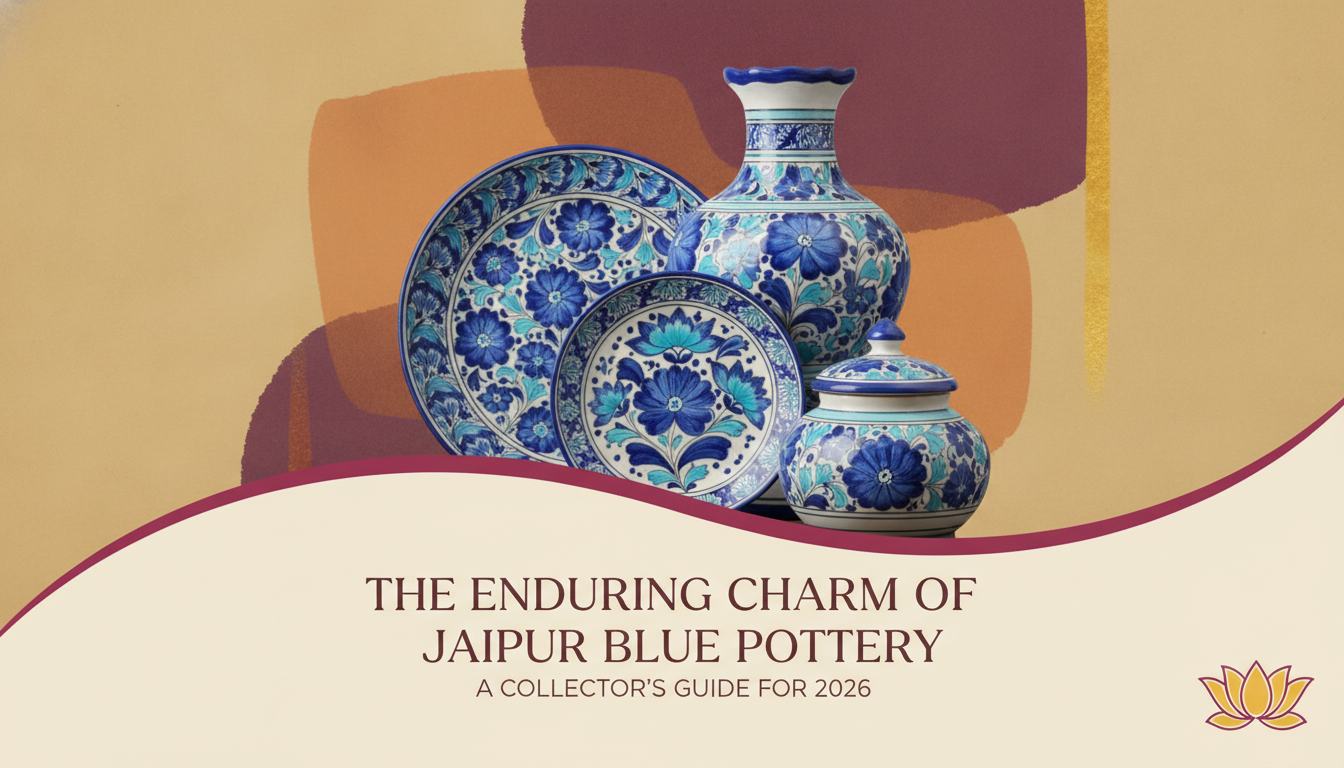
Pick up a piece of Jaipur blue pottery and you're holding something genuinely unusual: a ceramic object made without a single gram of clay. That fact alone stops most people mid-sentence. This guide is for tourists browsing the bazaars of the Pink City, expat Indians hunting for meaningful gifts, and home decor collectors worldwide who want to buy, appreciate, and care for these pieces with real confidence. According to UNESCO's Intangible Cultural Heritage documentation, traditional craft knowledge systems like blue pottery represent irreplaceable living heritage, and Jaipur blue pottery stands as one of India's most distinctive examples. Read on to learn everything, from spotting a fake to understanding why the craft is facing its biggest challenge in a generation.
What Is Jaipur Blue Pottery, and Why Is It Different?
Jaipur blue pottery is unlike any other ceramic tradition because it contains no clay. It's made from a paste of quartz powder, powdered glass, katira gond (a plant-based gum), and sodium sulphate, then fired at a relatively low temperature to produce its signature translucent, glassy surface.
Quartz-based ceramic: a fired, non-clay body made primarily from ground quartz and powdered glass, giving the finished piece its distinctive semi-opaque sheen.
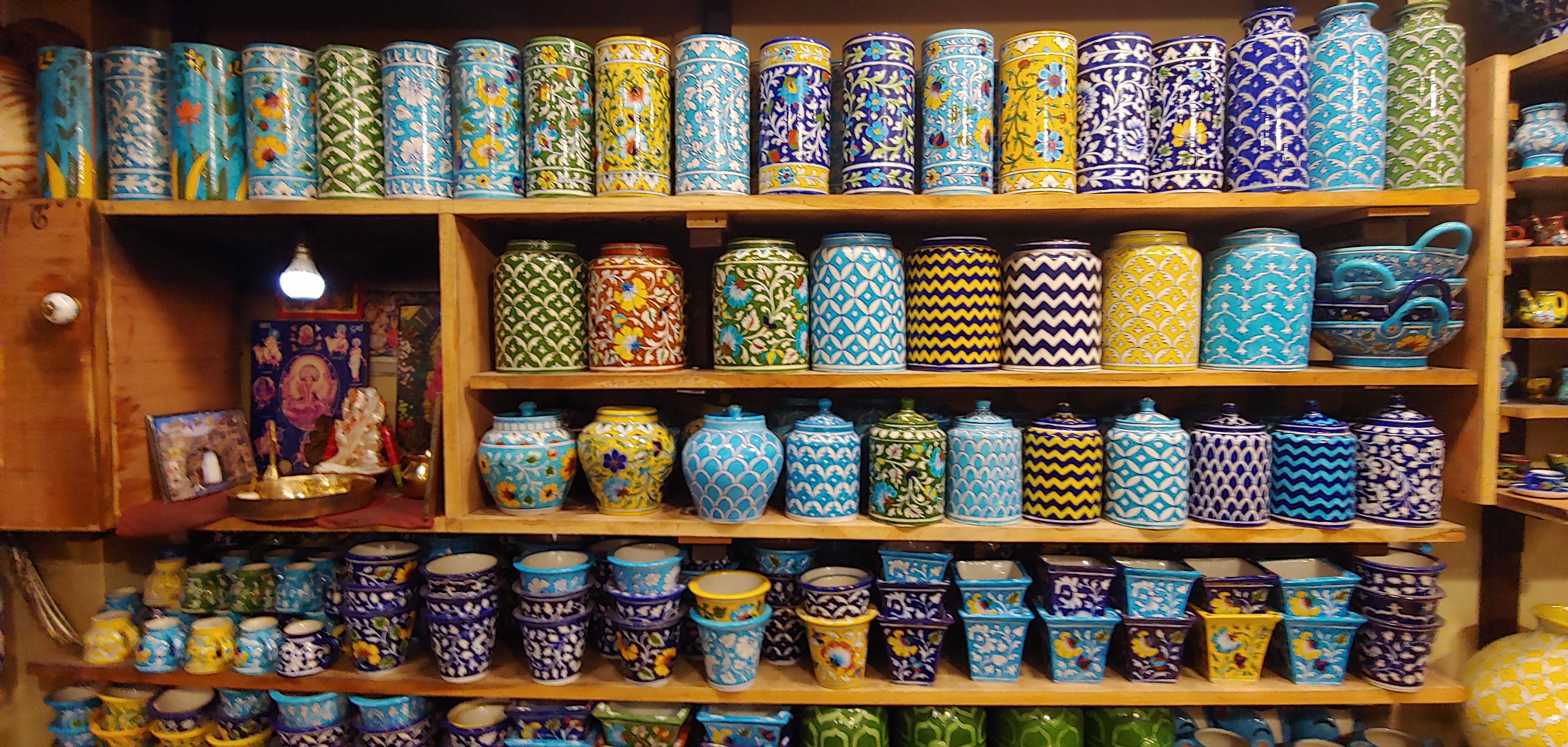
This composition is closer to Egyptian faience than to standard earthenware. The result is a body that's porous, lightweight, and noticeably cooler to the touch than regular pottery. The traditional palette centers on cobalt blue and white, though skilled craftspeople also use turquoise, green, and yellow on a white background.
The craft arrived in Jaipur via a long route: Persian artisans passed the technique through Afghanistan and into the Mughal courts, and Maharaja Ram Singh II brought it to Jaipur in the mid-19th century as a royal patronage project. By the early 20th century it had nearly disappeared. The artist Kripal Singh Shekhawat revived it through the 1950s and 1960s, and his name remains synonymous with the tradition's modern renaissance.
For a detailed look at the craft's origins and technique, Jaipur Stuff's deep-dive on blue pottery craftsmanship covers the full story behind this quintessential art form.
The Cultural Significance of Jaipur Blue Pottery
Jaipur blue pottery is not decorative novelty. It's a living record of cross-cultural exchange spanning Persia, Central Asia, Mughal India, and Rajasthan, compressed into every hand-painted tile, vase, and bowl.
The craft carries a Geographical Indication (GI) tag from the Government of India, which formally recognizes its exclusive geographic and cultural identity. According to the Office of the Controller General of Patents, Designs & Trade Marks, GI status protects traditional products from imitation and supports the livelihoods of the artisan communities attached to them.
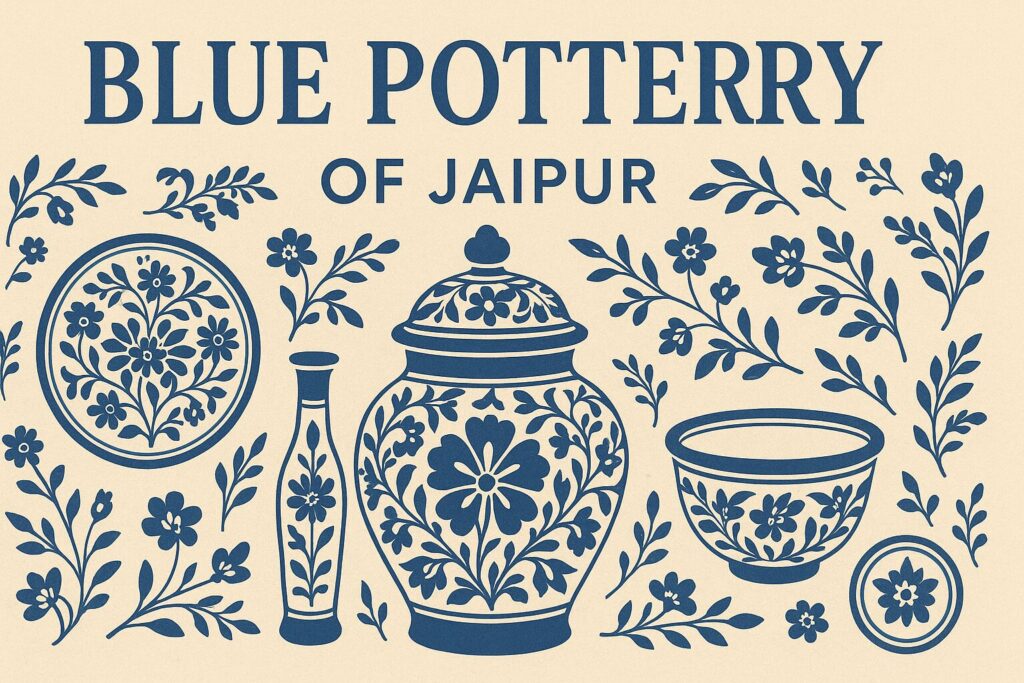
The motifs tell their own story. Lotus flowers reference Hindu symbolism. Arabesque patterns echo Islamic geometry. Animals like peacocks and deer appear alongside Chinese-influenced foliage. No other Indian craft form carries this density of cross-cultural reference in a single object.
That cultural layering is precisely why collectors and institutions take it seriously. The Wikipedia article on Blue pottery of Jaipur documents its material composition and historical lineage in detail, confirming the craft's documented roots stretch back at least three centuries.
You can see similar cross-cultural storytelling in many Jaipur handicrafts with aesthetic significance, but blue pottery holds a singular place because of its no-clay composition, which no other regional craft shares.
"Blue pottery of Jaipur is a rare surviving example of syncretic craft knowledge, where Persian, Mughal, and Rajput traditions merged into a uniquely Indian aesthetic.", Encyclopedia Britannica, Jaipur Arts entry
How Do You Tell Authentic Blue Pottery from a Replica?
Authentic Jaipur blue pottery feels lighter than it looks, shows slight surface irregularities under close inspection, and always has hand-painted designs that vary slightly from piece to piece. Machine-made or mass-produced replicas are perfectly uniform, heavier, and often have sharper, crisper lines that no human brush produces.
This is the question every first-time buyer needs answered before they spend a rupee.
The Five-Point Authenticity Check
Use this framework at any shop or online listing:
- Weight test: Hold the piece. Authentic quartz-based pottery feels surprisingly light for its size. Heavy pieces are almost certainly regular earthenware.
- Surface texture: Run your finger across the glaze. Genuine pieces feel slightly uneven, almost like smooth stone rather than glass. Perfect uniformity is a red flag.
- Design consistency: Compare two pieces of the same pattern side by side. Authentic hand-painted work shows minor variations in brushstroke thickness and color saturation. Identical pieces are machine-printed.
- Color palette check: Traditional authentic pieces use cobalt blue, white, turquoise, and green. Bright reds, purples, and hot pinks are modern additions, which aren't inauthentic by definition, but pieces sold as "traditional" using these colors warrant scrutiny.
- GI certification: Ask for a GI tag or documentation. Reputable sellers can provide this. Street-side stalls selling pieces at a fraction of workshop prices rarely can.
Where to Buy Blue Pottery in Jaipur
The most reliable places to buy authentic pieces are established workshops in Jaipur's Amer Road and Nehru Bazaar areas, as well as government-recognized craft emporia. The Rajasthan Government's official handicraft stores (known as Rajasthali outlets) are a safe starting point for first-time buyers because their stock is curated and certified. If you're visiting, bookmark our top travel tips to stay safe in Jaipur before you head out to the markets.
Collecting Jaipur Blue Pottery: Tips and Investment Value
Collecting Jaipur blue pottery tips center on three principles: buy from documented sources, prioritize craftsmanship quality over quantity, and focus on categories that hold value over time, specifically large decorative vases, tiles, and signed pieces from recognized master artisans.
Tips for New Collectors
- Start with functional pieces: Plates, mugs, and small bowls let you live with the craft daily and develop a trained eye before you invest in expensive decorative items.
- Document every purchase: Photograph the piece, note the workshop name, the artisan's name if available, the date, and the price. This provenance record matters if you resell.
- Prioritize singularity: One exceptional vase with complex hand-painted detailing outperforms ten mediocre bowls both aesthetically and financially.
- Attend craft fairs: The Jaipur Literature Festival and Dastkar craft melas regularly feature verified blue pottery artisans. Meeting makers directly is the most reliable authenticity guarantee.
- Mix periods: Pair older pieces, if you can source them, with contemporary work. The contrast reveals how the craft has evolved.
Jaipur Blue Pottery Investment Value
Is blue pottery from Jaipur a sound financial investment? The honest answer: it's a long-game proposition, not a quick-flip asset.
Pieces signed by known masters, particularly those associated with the Kripal Kumbha workshop lineage, have appreciated steadily at collector auctions and craft estate sales. Unsigned, mass-market pieces hold little resale value. The growing global interest in sustainable handcraft and the government's push for GI-tagged Indian exports are both structural tailwinds.
The Godawan whisky brand's September 2025 launch of a Collector's Edition cask series inspired by blue pottery motifs signals how the aesthetic is crossing into luxury lifestyle categories, and that kind of mainstream prestige moment historically lifts the underlying craft's market profile.
For broader context on where blue pottery fits among Jaipur's most promising collectible categories, see 6 best investment options in Jaipur.
| Piece Type | Collectibility | Resale Potential | Recommended For |
|---|---|---|---|
| Signed master artisan vase | Very High | High | Serious collectors |
| Large decorative tile panel | High | Medium-High | Interior design collectors |
| Functional tableware set | Medium | Low-Medium | First-time buyers |
| Unsigned decorative bowl | Low | Low | Gift buyers |
| Machine-printed replica | None | None | Avoid |
Modern Applications of Jaipur Blue Pottery in 2026
Modern applications of Jaipur blue pottery have expanded well beyond traditional vases and decorative plates. In 2026, the craft is appearing in architectural tile installations, luxury hospitality interiors, fragrance diffuser sets, and curated tableware collections for high-end restaurants.
This expansion is both exciting and contentious within the artisan community. Younger designers, particularly those trained at the National Institute of Design, are collaborating with traditional craftspeople to produce pendant lights, geometric wall art, and modular tile arrangements that would be unrecognizable to a 19th-century Jaipur potter.
The ETV Bharat report from January 2026 titled "Shades of Change: The New Face Of Blue Pottery In Rajasthan Village" documents how rural workshops are adapting by taking on custom orders from interior design firms in Dubai and Singapore, giving artisan families a more stable income stream than the tourist trade alone.
However, there's a real risk here. When commercial pressure prioritizes speed over skill, shortcuts enter the process. Some workshops now use acrylic-based colors rather than traditional mineral oxides to cut drying time. The resulting pieces look similar but lack the depth and durability of mineral-fired originals. Collectors should ask specifically whether mineral oxides or synthetic colorants were used.
Jaipur Blue Pottery Artisan Stories
The craft's survival depends entirely on individual artisan families, most of whom operate small workshops passed down through two or three generations. Understanding who makes blue pottery, and what pressures they face, makes every purchase more meaningful.
Kripal Singh Shekhawat's revival in the mid-20th century is the origin story everyone cites, but the contemporary scene is more complex. Several hundred artisan families in Jaipur practice the craft today, concentrated in areas around Sanganer and Amer Road. Many are second-generation potters who learned from parents who themselves learned during the post-revival boom of the 1970s and 1980s.
The ETV Bharat piece from 2025 titled "Why Pink City's Ancient Iranian Blue Pottery Art Is Facing Existential Crisis" is a sobering read. It documents how younger family members are abandoning the craft for better-paying urban jobs, and how the labor-intensive six-to-eight-week production cycle per batch makes it nearly impossible to compete on price with machine-made alternatives.
Buying directly from artisan workshops, rather than souvenir shops that merely stock the work, sends money to the right place. The Jaipur Stuff piece on artisans preparing biodegradable Diwali diyas shows the same artisan community adapting across craft traditions, which underlines why consumer choices matter.
According to the Ministry of Textiles, Government of India's handicraft development reports, the handcraft sector employs over seven million artisans across India, making it the second-largest rural employer after agriculture. Blue pottery artisans in Jaipur are a small but symbolically important part of that ecosystem.
Jaipur Blue Pottery Care and Maintenance
Jaipur blue pottery care and maintenance is straightforward but non-negotiable. Because the quartz body is porous and the low-fire glaze is softer than high-fire ceramics, these pieces require gentle handling and specific cleaning habits to stay beautiful for decades.
Follow these rules without exception:
- Hand wash only: Dishwashers use water temperatures and detergents that degrade the glaze over repeated cycles. Always wash by hand with mild soap and lukewarm water.
- No prolonged soaking: The porous body absorbs water if left submerged. Wash quickly and dry thoroughly.
- Avoid sudden temperature changes: Don't move a piece from a cold room to a hot surface or vice versa. Thermal shock can hairline-crack the glaze.
- Display away from direct sunlight: Prolonged UV exposure fades mineral-oxide colors, particularly the blues and turquoises.
- Store with padding: When stacking pieces, place a soft cloth or foam sheet between them. The glaze chips more easily than standard ceramics.
- Use felt pads on bases: Unglazed bases can scratch wooden furniture. Stick self-adhesive felt pads to the bottom of every piece you display.
A piece handled carefully can last centuries. Poorly maintained pieces chip, craze, and fade within a decade.
What Are the Jaipur Blue Pottery Trends for 2026?
Jaipur blue pottery trends 2026 point toward three dominant directions: maximalist tile installations in luxury interiors, earth-tone palette expansions that blend traditional cobalt with terracotta and gold, and limited-edition collaborations between heritage workshops and contemporary product designers.
The social media effect is real. The craft's photogenic quality, particularly its striking cobalt-on-white contrast, has made it a staple of interior design content on Instagram and Pinterest. That visibility is pushing demand globally while simultaneously creating pressure to produce faster and cheaper.
The most interesting development this year is the formalization of collector's editions. The Godawan whisky collaboration in late 2025 proved that blue pottery aesthetics translate powerfully into luxury lifestyle branding. Expect more collaborations with fashion, fragrance, and hospitality brands through 2026.
For collectors, the collector's edition category is worth watching closely. Limited runs authenticated by named workshops and specific artisans will likely command meaningful premiums within five to ten years.
Key Takeaways
- Jaipur blue pottery is made without clay, using a quartz-and-glass paste that gives it a distinctive lightweight, translucent quality unlike any other Indian ceramic tradition.
- Authenticity markers include lighter-than-expected weight, slight surface irregularities, hand-painted design variations, and GI certification from the seller.
- Investment value is real but selective: signed master-artisan pieces and large decorative works appreciate; unsigned mass-market items do not.
- The craft faces an existential crisis as younger artisans leave for higher-paying urban work, making direct-from-workshop purchases a meaningful act of preservation.
- Care is simple but strict: hand wash only, no soaking, avoid thermal shock, keep out of direct sunlight, and pad storage surfaces.
- 2026 trends favor collector's editions, luxury brand collaborations, and architectural tile applications, all of which are expanding the craft's global footprint.
- Buying from authenticated sources, whether physical workshops in Jaipur or curated online retailers, is the single most important decision a new collector makes.
FAQs
Where to buy blue pottery in Jaipur?
The most reliable sources are government-recognized craft emporia (Rajasthali stores), established workshops on Amer Road and in Sanganer, and curated online retailers like Jaipurstuff.com. Avoid unverified street stalls selling pieces at unusually low prices, as these are almost always mass-produced replicas without GI certification.
Blue pottery Jaipur se sambandhit shilpkar ka naam kya hai?
Jaipur blue pottery ka sabse prasiddh shilpkar Kripal Singh Shekhawat hain, jinhone is kala ko 1950-60 ke dashak mein punarjiivit kiya. Unka workshop Kripal Kumbha aaj bhi ek reference point hai. Aaj kai artisan parivaar Sanganer aur Amer Road ke aaspaas is parampara ko jeeivit rakh rahe hain.
What makes Jaipur blue pottery unique compared to other pottery?
Jaipur blue pottery contains no clay. Its body is made from quartz powder, powdered glass, and plant-based gum, fired at low temperatures. This gives it a lighter weight, a glassy semi-translucent finish, and a softer glaze than standard earthenware or stoneware, making it visually distinctive and technically unlike any other Indian ceramic form.
How do I care for and maintain blue pottery pieces?
Always hand wash with mild soap and lukewarm water. Never soak or put pieces in a dishwasher. Avoid direct sunlight and sudden temperature changes. Pad storage surfaces and place felt pads on unglazed bases. With this routine, a quality piece can remain in excellent condition for generations.
Is Jaipur blue pottery a good investment?
Pieces signed by recognized master artisans and large decorative works from documented workshops have appreciated steadily at collector sales. Unsigned, mass-market pieces hold minimal resale value. The GI tag, growing global interest in handcraft, and luxury brand collaborations are all positive long-term signals for the craft's collectible market.
How can I tell if blue pottery is authentic?
Check for lighter-than-expected weight, slight glaze irregularities, hand-painted design variations between identical-pattern pieces, and a GI certification from the seller. Authentic pieces are also priced to reflect significant hand-labor. Suspiciously cheap, perfectly uniform pieces are almost always machine-printed replicas.
What are the most popular jaipur blue pottery designs?
Traditional jaipur blue pottery designs include lotus flowers, peacocks, deer, fish, and arabesque geometric patterns on a white background in cobalt blue, turquoise, and green. Contemporary workshops now also produce abstract geometric patterns, minimal line-work, and earth-tone palette variations to meet modern interior design demand.
Ready to bring a piece of this living heritage into your home? Explore Jaipurstuff.com's curated collection of Jaipur blue pottery and Rajasthani handicrafts and find pieces that genuinely resonate with your style, sourced with the care and authenticity this extraordinary craft deserves.