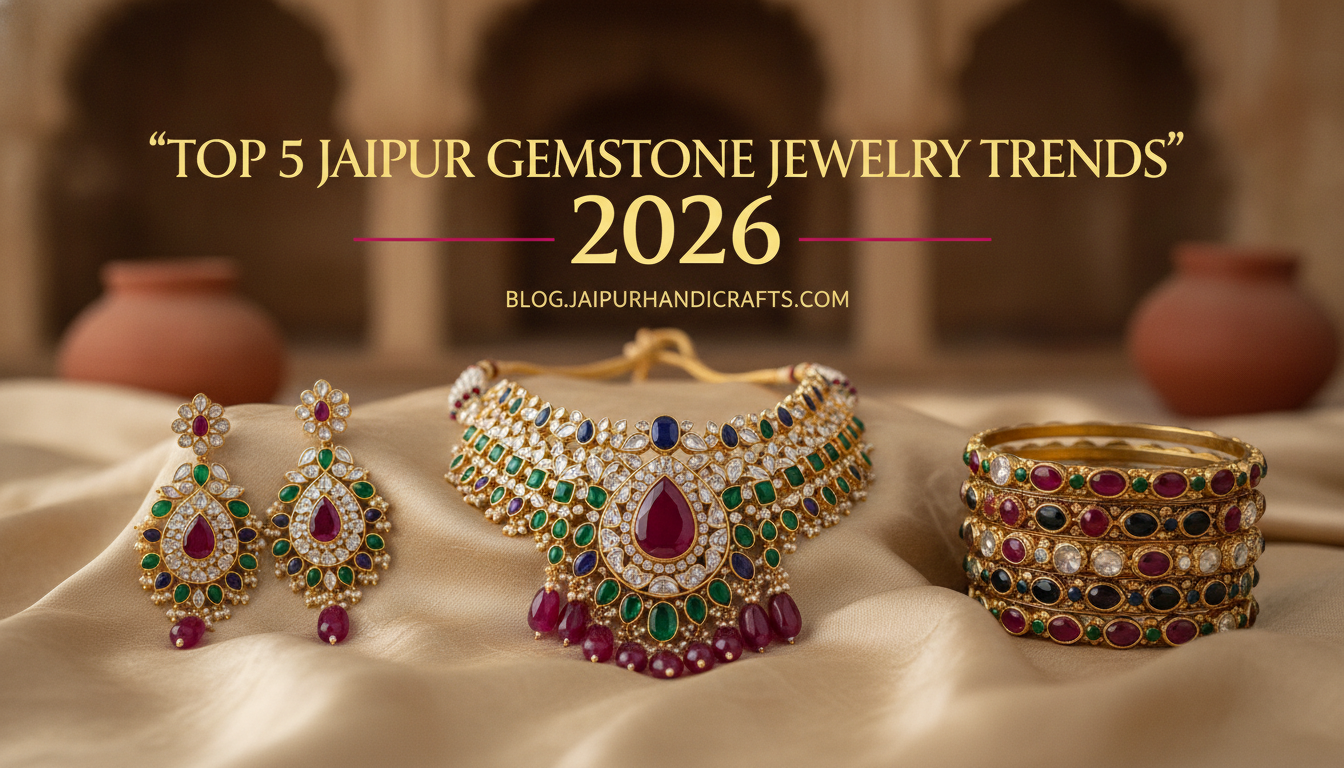
Walk into Johari Bazaar on a busy morning and you'll understand immediately why Jaipur has been called the gemstone capital of the world. The air smells of marigolds and silver polish, and every shopfront blazes with rubies, emeralds, sapphires, and stones you won't find easily anywhere else. Jaipur gemstone jewelry isn't just an accessory category. It's a living craft tradition shaped over four centuries, and in 2026 it's undergoing one of its most exciting creative moments yet.
This guide covers the five trends reshaping the market this year, plus the context every buyer needs: the history behind Jaipur's dominance, how to spot authentic pieces, what gemstones define the Rajasthani tradition, and what the cultural stakes actually are when you make a purchase.
Why Jaipur Became the World's Gemstone Capital
The story starts with Maharaja Sawai Jai Singh II, who founded Jaipur in 1727 and actively invited artisans, gem cutters, and jewelers from across India and Central Asia to settle in the new Pink City. The history of Jaipur is inseparable from the history of its gem trade: royal patronage created workshops that passed skills down across generations, and the city's position on ancient trade routes meant steady access to rough stones from Burma, Sri Lanka, and Afghanistan.
By the 20th century, Jaipur had become the world's largest center for cutting and trading colored gemstones, a status examined in detail by the Gemological Institute of America. The city's karigars (master craftsmen) developed proprietary techniques for faceting, setting, and enamelwork that are genuinely difficult to replicate elsewhere. These aren't just aesthetic achievements. They're competitive advantages built over centuries.
A cluster mapping study by NCAER identified Jaipur as one of India's most significant handicraft production clusters, with deep supply-chain integration running from rough stone sourcing through finished retail. That density of specialized skill in a single geography is what makes Jaipur's output qualitatively different from other Indian jewelry centers.
The Gemstones That Define Rajasthani Jewelry
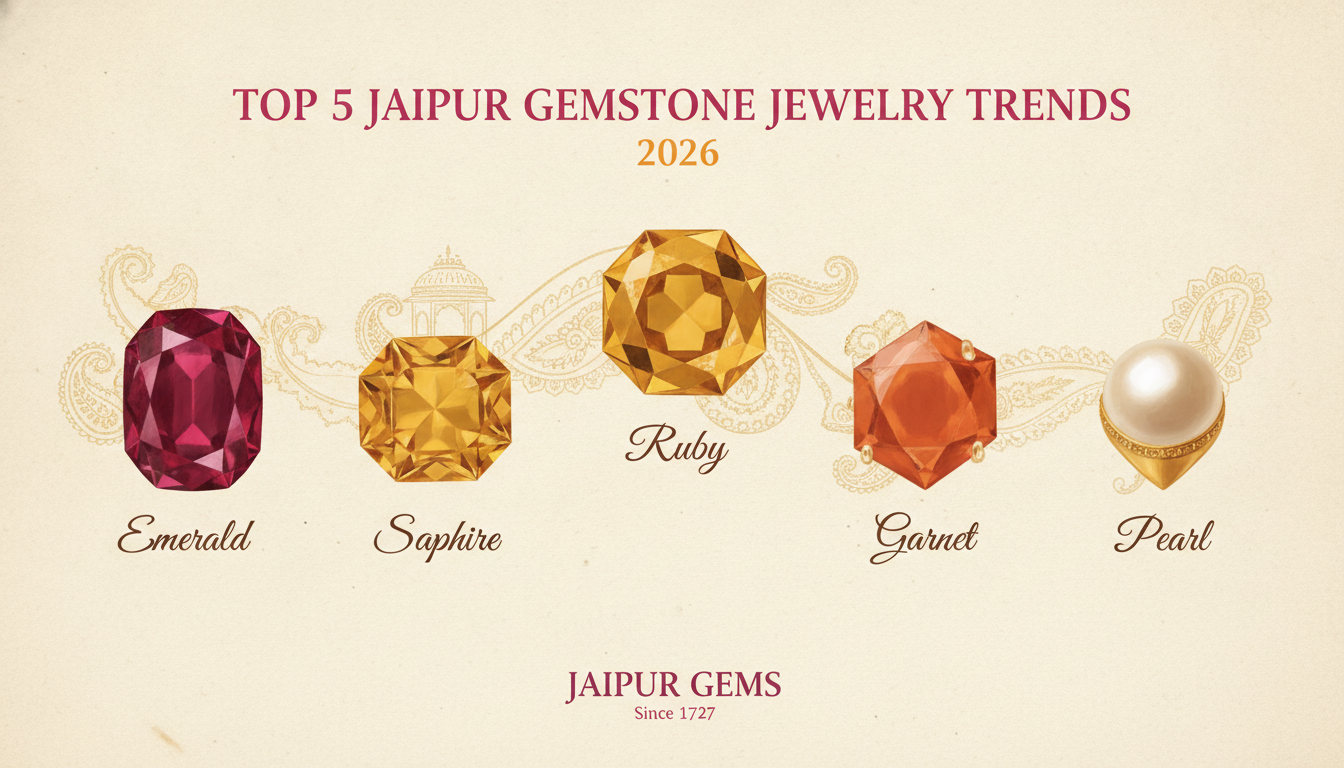
Before diving into trends, it helps to know which stones are actually central to the tradition, because not everything sold as "Jaipur jewelry" is equally authentic.
Emeralds (Panna): Jaipur is famous for emerald cutting. The city processes Colombian, Zambian, and Indian-origin stones, and its karigars are particularly skilled at working with inclusions in ways that enhance rather than hide a stone's character.
Rubies and Sapphires: Historically sourced from Burma and Sri Lanka, these corundum stones are a staple of Kundan and Meenakari work.
Turquoise: Widely used in tribal and folk jewelry styles from western Rajasthan. Genuine turquoise is increasingly rare; buyers should ask specifically about origin.
Citrine, Amethyst, and Aquamarine: More accessible price points, but still handled with serious craft skill in Jaipur's workshops.
Moonstone and Labradorite: These feldspar stones have surged in popularity over the last decade for their play-of-light effects and their fit with contemporary minimalist aesthetics.
Carnelian, Onyx, and Unakite: Used extensively in beadwork and silver jewelry. Jaipur's wholesale bead market is one of the largest in the world.
The GIA's research on Jaipur notes that the city processes an extraordinary variety of colored stones simultaneously, making it unlike any other single jewelry-making center on earth. That variety is exactly what fuels the trend directions below.
Top 5 Jaipur Gemstone Jewelry Trends to Watch in 2026
The global natural gemstone and jewelry market is projected to expand significantly through 2026, with colored stone categories outperforming the broader fine jewelry segment. Jaipur sits at the forefront of that growth, both responding to global demand and actively driving new creative directions from the ground up.
1. Kundan Polki Gets a Modern Reset
Kundan is one of India's oldest jewelry-making techniques, a setting method where gemstones are encased in pure gold foil rather than held by prongs. Polki uses uncut, natural diamonds in the same tradition. For the last decade, both techniques were mostly reserved for bridal wear, which limited their commercial reach to weddings and festival seasons.
In 2026, designers are pulling Kundan and Polki into everyday luxury. The pieces are smaller, lighter, and stripped of the heavy layering associated with bridal sets. Think single-stone Kundan studs with clean geometric frames, or Polki pendants on 22-carat chains fine enough to layer with contemporary outfits. The stones and the setting technique are unchanged. The scale and context are new.
This trend is worth watching for collectors specifically because it signals staying power rather than a seasonal moment. When a technique that took centuries to perfect starts being applied at new scales, it tends to generate an enduring category, not just a passing fashion.
2. Ethical Sourcing as a Selling Point, Not Just a Checkbox
Buyer expectations have genuinely shifted. Customers in Europe, North America, and among the Indian diaspora are asking specific questions before purchasing: Where did this emerald come from? What treatments has it undergone? Can you show me documentation?
Jaipur's established traders are responding. Several major workshops have partnered with Fairtrade-aligned mining cooperatives in Zambia for emeralds and with traceable Colombian sources for other stones. Certifications from GIA and the International Gemological Institute are becoming standard paperwork rather than premium add-ons.
The business case is clear. A GJEPC market insights report from April 2025 highlights that US buyers, Jaipur's largest export market, are increasingly prioritizing provenance documentation when choosing suppliers. Separately, a February 2026 trade agreement eliminating tariffs on Indian gems and jewelry entering the US market has accelerated this push, giving Jaipur exporters a strong commercial incentive to formalize sourcing records.
For the traveler or online buyer, the practical implication is simple: expect and demand a gemstone certificate for any significant purchase. A reputable seller won't hesitate.
3. Color Maximalism: Bigger, Bolder, Brighter
After years of minimalism dominating global fine jewelry, 2026 belongs to color. And nobody does color quite like Jaipur.
The trend here is multi-stone compositions where color contrast is the entire point: deep blue sapphires set alongside pale green peridot, vivid orange carnelian combined with cold white moonstone, and layered rings stacking three or four different stones across a single hand. Rajasthani jewelry has always embraced bold color combinations, particularly in traditional necklaces and bajubands (upper arm cuffs), but the new iteration applies that bravery to rings, stacking bracelets, and earring sets designed explicitly for international buyers.
What makes this trend particularly interesting is that it plays to Jaipur's actual strengths. The city's stone cutters and setters have worked with dozens of stone varieties simultaneously for generations. They understand color relationships intuitively. When global fashion demands maximalism, Jaipur doesn't pivot, it simply makes visible what it's always been good at.
The NCAER cluster study documents how Jaipur's production infrastructure, with specialized clusters handling different stone types, enables exactly this kind of multi-material coordination at scale. The city is structurally built for this trend.
4. Meenakari Meets Contemporary Gemstone Setting
Meenakari is the art of enameling metal, specifically fusing colored glass powders onto gold or silver using heat. Jaipur's Meenakari work, typically in vivid blues, greens, reds, and yellows, is recognized among the Jaipur handicrafts with genuine aesthetic significance and has been practiced here for over 400 years. It requires decades of mastery and cannot be mechanized, which is precisely why it remains concentrated in the Pink City.
Historically, Meenakari appeared on the reverse face of Kundan jewelry, an open secret among collectors, who often prize the enamel back as much as the gemstone front. In 2026, that logic has flipped. A new wave of designers is bringing the enamel to the front face, using it as a chromatic background for single spectacular stones or as a color field contrasting with diamond accents.
If you encounter a piece where the enamel and the gemstone feel like a unified composition rather than decoration layered onto a setting, you're looking at one of the more genuinely original developments in authentic Jaipur gemstone jewelry right now. These pieces are also among the most collectible, because the combination of two time-intensive crafts in a single object is genuinely rare.
5. Bespoke Digital Commissions Going Mainstream
Custom jewelry has always been possible in Jaipur. The craft infrastructure, stone merchants, goldsmiths, gem cutters, and polishers all within a few kilometers of each other in the old city, makes bespoke orders fast and cost-effective compared to Western markets.
What's changed in 2026 is the reach. Social media and WhatsApp-enabled commerce have made it practical for diaspora buyers in the UK, US, Canada, and Australia to commission pieces directly from Jaipur workshops: share reference images, approve designs digitally, and receive finished jewelry in 10 to 14 days. The GJEPC's US-India market insights report points to direct-to-consumer digital channels as the fastest-growing segment for Indian jewelry exports.
For buyers, this trend opens access to genuinely handcrafted, personalized pieces at a fraction of what a Western jeweler charges for mass-produced alternatives. For Jaipur's artisans, it creates ongoing relationships rather than one-off transactions, which matters for the craft's long-term survival.
How to Identify Real Jaipur Gemstones: A Practical Checklist
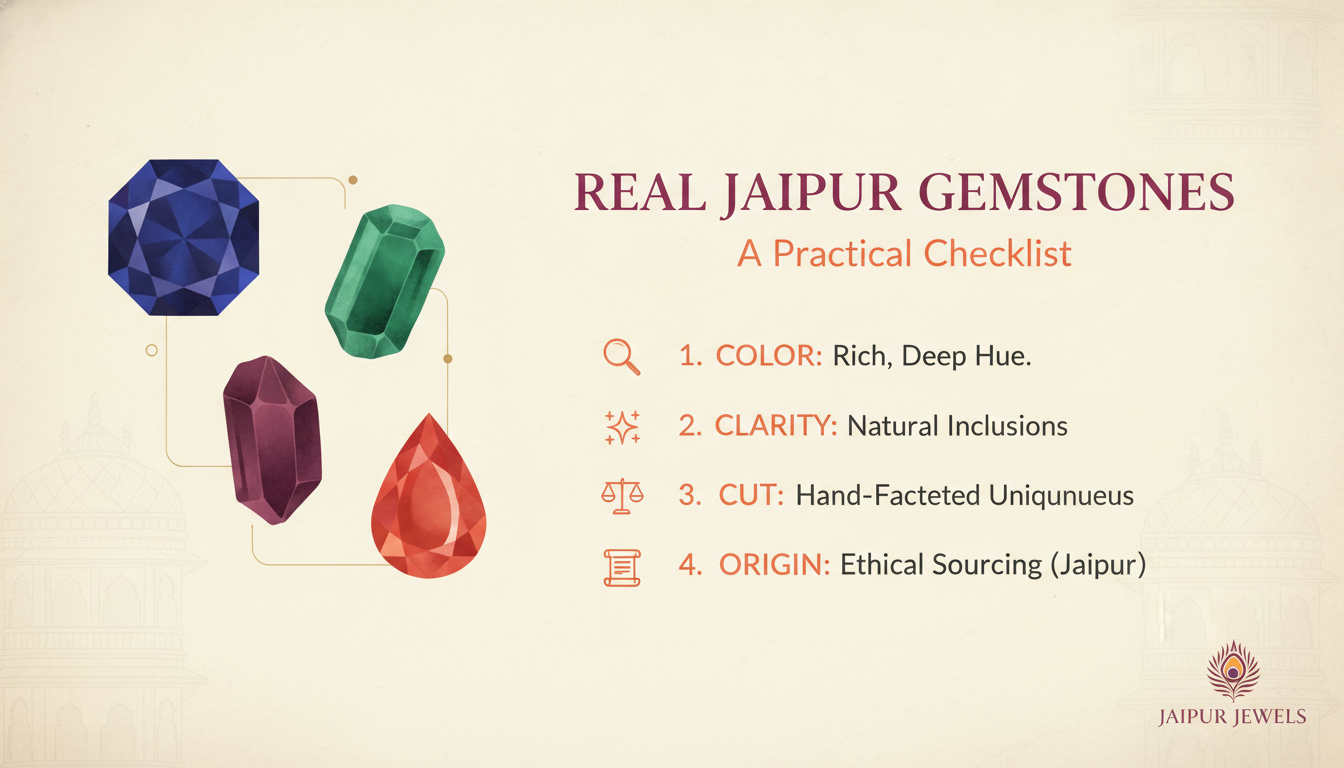
This is where buyers most often get caught out. Here's a direct framework:
Ask for certification. For any emerald, ruby, or sapphire above a few thousand rupees, a certificate from GIA, IGI, or the Gemological Institute of India should be standard. If a seller refuses or says it's unnecessary, treat that as a serious warning sign.
Examine the setting. Authentic Kundan work shows hand-placed, slightly irregular foil under each stone. Machine-set imitations have a uniform, almost plastic appearance to the foil. The difference is visible to the naked eye once you know what you're looking at.
Check the weight. Natural gemstones are denser than glass imitations. A genuine ruby or emerald feels noticeably heavier than a glass simulant of the same visible size.
Ask specific questions. Where is this stone from? What treatment has it undergone? What's the approximate carat weight? A knowledgeable seller will answer without hesitation. Vague or defensive responses indicate a problem.
Choose accountable sellers. Taking a heritage walk through Jaipur's old city will orient you around which sections of Johari Bazaar have long-standing, reputation-conscious businesses versus more transient tourist-facing stalls. That context is hard to get from a map alone.
One common mistake worth flagging: assuming "handmade" and "authentic gemstone" always go together. Jaipur produces beautiful handmade silver jewelry set with glass, resin, and synthetic stones. These are honest products at honest prices. The issue arises only when a glass-set piece is presented as natural stone. Know which category you're buying in, and ask clearly.
What You're Actually Buying: The Cultural Dimension
Jewelry in Rajasthan isn't primarily decorative. It functions as a communication system. Specific stones, metals, and setting techniques signal community identity, marital status, spiritual protection, and family wealth in ways that are still actively understood by the people who make and wear these pieces.
In Vedic tradition, gemstones correspond to planets: emeralds to Mercury (clarity of thought and communication), rubies to the Sun (confidence and vitality), blue sapphires to Saturn (power and discipline, treated with care because the planet's influence is considered strong), pearls to the Moon (emotional balance), and yellow sapphires to Jupiter (wisdom and prosperity). This framework isn't superstition for most buyers who engage with it. It's a sophisticated interpretive system for understanding a stone's role in a person's life.
For collectors, gift-buyers, and cultural enthusiasts, this means you're participating in a living tradition rather than purchasing a static object. That's a meaningful distinction. It also means it's worth asking the craftsman or seller what a piece traditionally signifies. The conversation itself will add something to what you take home.
Where to Buy: A Practical Comparison
Jaipur offers three distinct buying environments, each with different trade-offs worth understanding before you spend.
| Buying Environment | Best For | Watch Out For |
|---|---|---|
| Johari Bazaar, old city | Widest variety, price negotiation possible | Tourist markup; requires knowledge to navigate |
| Government-certified emporia (e.g., Rajasthali) | Reliable quality standards, fixed prices | Less variety; limited bespoke options |
| Verified online sellers | Convenience, diaspora access, comparison shopping | Seller credentials need careful verification |
For online purchases, the minimum acceptable standard is: lab certification available on request, a clear return or exchange policy, and willingness to do a video call showing the piece before payment. The best Jaipur handcrafted jewelry online sellers now treat video viewings as routine rather than exceptional.
If you're visiting in person, investing a couple of hours in a structured old-city exploration will significantly improve your buying confidence. The historical and cultural context you absorb makes you a harder target for mispricing and a more discerning judge of quality.
Key Takeaways
- Jaipur has been a global gemstone hub since the 18th century. Its artisan infrastructure, dense, specialized, and multi-generational, produces quality that other centers don't consistently replicate.
- The five trends defining Jaipur gemstone jewelry in 2026 are: modernized Kundan and Polki, ethical sourcing with documentation, color maximalism, Meenakari-gemstone fusion on the front face of pieces, and bespoke digital commissions reaching diaspora buyers directly.
- Real gemstones can be verified through lab certification, physical examination (weight and setting quality), and direct questioning of sellers. For significant purchases, always ask for documentation.
- The global natural gemstone jewelry market is growing, with colored stones outperforming other fine jewelry categories heading into 2026.
- The India-US tariff agreement of early 2026 is actively reshaping Jaipur's export market and pushing exporters toward better sourcing transparency, which benefits buyers.
- Rajasthani jewelry carries cultural meaning beyond decoration. Understanding that context, even briefly, improves both the buying experience and what the piece means over time.
- Buying from accountable sources, whether in Jaipur's old city or through verified online platforms, protects your investment and sustains the artisans who keep this tradition alive.
Frequently Asked Questions
What makes Jaipur gemstone jewelry different from other Indian jewelry traditions?
Jaipur jewelry is distinguished by its colored stone expertise, specifically the city's centuries-old gem-cutting industry and its mastery of setting techniques like Kundan and Meenakari enamelwork. The combination of a dense artisan cluster, direct access to global stone supplies, and multi-generational skill transfer produces a quality and variety that other Indian jewelry centers don't replicate as consistently.
Which gemstones are most commonly used in Rajasthani jewelry?
Emeralds, rubies, sapphires, turquoise, citrine, amethyst, moonstone, and carnelian are all traditional to Jaipur's output. Emeralds and rubies represent the prestige tier; moonstone and amethyst offer genuine beauty at more accessible price points. For many buyers, Vedic astrological associations also guide stone selection based on personal birth charts.
How can I tell if a Jaipur gemstone is real rather than synthetic?
Ask for a lab certificate from GIA, IGI, or GII, reputable sellers provide these for meaningful purchases. Examine the setting: authentic Kundan work shows hand-placed, slightly irregular foil. Natural stones also feel denser than glass imitations of the same visible size. The most reliable protection remains buying from accountable sellers who provide documentation without being asked twice.
What are the best places to buy gemstone jewelry in Jaipur?
Johari Bazaar in the old city offers the widest variety and room for price discussion. Government-run emporia like Rajasthali provide quality assurance at fixed prices. For international and diaspora buyers, verified online sellers offering lab certifications and video viewings before purchase are a practical and increasingly reliable option.
Is buying Jaipur handcrafted jewelry online safe?
Yes, with the right precautions. Look for sellers who provide lab certifications, offer video viewings of pieces before payment, and have clear return or exchange policies. The 2026 India-US trade agreement has also improved documentation standards for exported pieces, making the paper trail easier to follow for buyers in North America.
What is Kundan jewelry and why is it associated specifically with Jaipur?
Kundan is a setting technique where gemstones are embedded in highly refined gold foil rather than held by metal prongs. It originated in Mughal-era royal workshops and was refined by Jaipur's karigars over centuries. The result is a piece where the stone appears to float in gold. Authentic Kundan cannot be mechanized and requires exceptional learned skill, which is why production remains concentrated in Jaipur.
What is the cultural meaning of gemstones in Indian jewelry?
In Vedic tradition, gemstones correspond to planets and are worn to strengthen beneficial planetary influences: emeralds for Mercury, rubies for the Sun, blue sapphires for Saturn, pearls for the Moon, and yellow sapphires for Jupiter. Beyond astrology, specific pieces and stone choices signal community identity, marital status, and family heritage within Rajasthani cultural practice, meanings that still carry weight for many buyers today.
How much should I expect to pay for authentic Jaipur gemstone jewelry?
Prices range widely. Silver jewelry with semi-precious stones starts around INR 500 to 2,000 for simple pieces. Genuine Kundan sets with natural emeralds or rubies reach INR 50,000 to several lakhs. Gold Polki bridal sets command premium prices. Always compare multiple sellers and ask for documentation before committing to any significant purchase.
Ready to explore a curated selection of authentic pieces from the Pink City? Browse Jaipur Stuff's collection of handcrafted Rajasthani jewelry and cultural treasures at Jaipurstuff.com and find something that carries a genuine story.