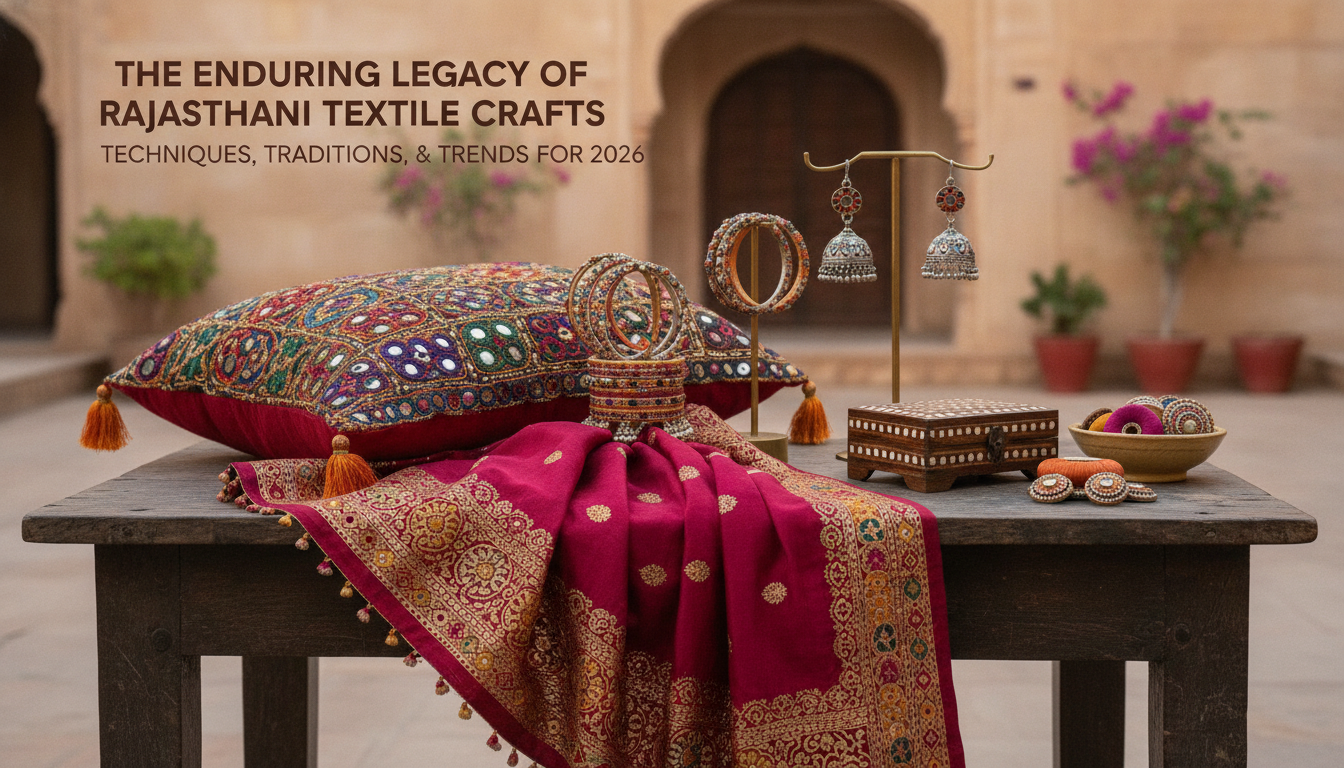
Walk through any bazaar in Jaipur and you feel it before you fully see it: bolts of indigo-printed cotton catching the afternoon light, bandhani dupattas trembling in the breeze, embroidered panels so dense with threadwork they seem to pulse. Rajasthani textile crafts are not museum pieces. They are a living, working tradition practiced daily by artisan communities whose skills stretch back centuries, and in 2026 they are attracting more global attention than at any previous point.
This guide covers what every serious buyer, traveller, or decor enthusiast needs to know: the major techniques and what genuinely distinguishes one from another, the embroidery traditions that define regional identity, the cultural weight behind every stitch, and exactly what to look for when buying authentic pieces.
A Tradition Built on Royal Patronage and Desert Ingenuity
Rajasthan's textile heritage was shaped by three forces acting together: the demands of Rajput royalty, the trade routes crossing the Thar Desert, and the resourcefulness of communities who turned local plants, natural dyes, and portable looms into something extraordinary.
The history of Jaipur as a planned city founded in 1727 by Maharaja Sawai Jai Singh II is directly relevant here. Artisan communities called mohallas were deliberately settled inside the city walls by craft type. Printers clustered in Sanganer. Dyers organized along specific lanes. Weavers established themselves in neighborhoods still active today. Royal courts demanded quality and variety, which drove techniques to their highest expression over generations.
Each region developed its own signature. Jaipur became synonymous with block printing and gota patti embroidery. The Jodhpur region gave rise to bandhani tie-dye. Barmer developed bold applique with mirror inlays. Kota, on the Chambal River, refined a uniquely lightweight woven textile. This geographic distribution of expertise reflects centuries of community specialization, as documented in academic research on Indian textile traditions (Digital Commons, University of Nebraska).
The result is a state with more distinct textile traditions than most countries possess in total.
The Core Techniques: Six Practices Every Textile Enthusiast Should Know
Rajasthani fabric arts span hand printing, resist dyeing, weaving, and embroidery. Here is how the most important techniques actually work and what makes each one distinct.
Block Printing: Sanganeri and Bagru
Hand block printing is what most visitors picture first, and it comes in two regional styles that are frequently confused.
Sanganeri printing uses finely carved wooden blocks on a white or off-white base cloth. The motifs are delicate: small florals, paisley sprigs, trailing vines. Colors tend toward soft rose, sky blue, and sage green. The fabric reads as clean and contemporary even though the technique is centuries old.
Bagru printing is rawer and more graphic. Artisans in Bagru use natural dyes derived from indigo, pomegranate rind, and iron-rich black alongside a mud-resist method. The base cloth is often cream or pale ochre. Motifs carry more contrast and visual weight. A genuine Bagru-printed cloth has slight irregularities that no machine process can replicate.
Both traditions face pressure from cheaper digital alternatives. A strategic roadmap commissioned by the Export Promotion Council for Handicrafts identifies block printing as a key export driver and recommends specific policy interventions to protect artisan livelihoods (EPCH, 2024).
Bandhani and Leheriya: Two Takes on Tie-Dye
These are both resist-dye techniques, but they produce completely different visual results.
Bandhani creates a field of tiny dots across the fabric. An artisan pinches and ties thousands of small knots in the cloth before dipping it in dye. When the ties are removed, each point resists the color and appears as a small circle. A wedding sari with dense bandhani work can take weeks of hand-tying alone. The finest pieces use silk rather than cotton.
Leheriya translates roughly as "wave pattern" and produces diagonal stripes in multiple colors. The fabric is rolled diagonally around a stick, tied at intervals, and dyed. When unrolled, the result is a cascade of slanted color bands. Leheriya is closely associated with the monsoon festival of Teej in Jaipur, when women traditionally wear fresh leheriya turbans and dupattas.
The two techniques are sometimes combined in a style called mothda, which overlays both patterns for extreme visual complexity.
Dabu: The Mud-Resist Method
Dabu printing is less familiar to international buyers but deserves serious attention. Artisans apply a paste made from clay, wheat chaff, and lime to block-printed areas of cloth. The paste resists the subsequent dye bath, leaving covered areas undyed while exposed areas absorb color. The dried mud is then cracked off to reveal the final pattern.
The process is slow, smells distinctly of the earth, and produces a soft matte quality that no digital print can fake. The Chippa community of Bagru has preserved this technique for generations, and it has been documented as part of wider global efforts to protect intangible cultural heritage (UNESCO, 2022).
Kota Doria: Weaving Lightness into Fabric
Kota Doria is a woven fabric rather than a printed one, and it stands entirely apart from the rest of Rajasthan's textile repertoire. Woven on handlooms in the town of Kota using alternating cotton and silk threads in a specific check pattern called khats, the resulting fabric is extraordinarily light and slightly translucent. It drapes beautifully, breathes in desert heat, and has a subtle texture visible only when held to light.
Genuine Kota Doria carries a Geographical Indication (GI) tag, meaning only cloth woven in Kota district by registered weavers can legally use the name. Power-loom counterfeits are widely sold. The real thing has a slightly uneven weave visible up close and a price that reflects the labor involved.
Traditional Rajasthani Embroidery: A Region-by-Region Guide
Embroidery is the most personal of Rajasthan's textile traditions. Each community, sometimes each village, developed its own stitch vocabulary as a way of marking identity and social status.
| Embroidery Style | Region | Defining Features |
|---|---|---|
| Gota Patti | Jaipur | Ribbons of zari fabric appliqued onto base cloth in floral and geometric shapes |
| Zari Zardozi | Jaipur / Ajmer | Heavy metallic threadwork on velvet or silk, historically used for royal garments |
| Kashida | Barmer / Jaisalmer | Dense geometric patterns, mirror inlays (shisha), bold color contrasts |
| Phulkari (Rajasthani variant) | Shekhawati region | Floral silk embroidery on cotton, lighter in coverage than Punjabi phulkari |
| Applique | Barmer | Fabric cutouts stitched onto base cloth, often depicting elephants and peacocks |
Gota Patti deserves special mention because it is experiencing a genuine global revival. The technique of applying thin strips of zari ribbon in dimensional patterns was originally developed for Rajput bridal wear. Today, designers from Mumbai to Milan are incorporating it into contemporary silhouettes. Its renewed visibility is part of a broader co-creation movement between traditional artisans and modern designers, explored in depth by the National Institute of Fashion Technology (NIFT, 2024).
The Cultural Weight Behind Every Thread
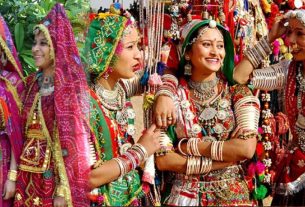
Rajasthani textiles are not decorative extras. They mark every major life event: birth, betrothal, marriage, death. A bride's dowry traditionally included specific textiles by type and quantity that communicated her family's status and regional origin. The patterns were not arbitrary. They were coded messages about community, devotion, and belonging.
Color carried specific meaning. Saffron represented valor and sacrifice. Red signified prosperity and bridal auspiciousness. Indigo blue, once more valuable than gold in parts of Rajasthan, indicated connection to major trade routes. Even today, Jaipur is famous partly because the visual language of its textiles remains intact and legible in everyday street life.
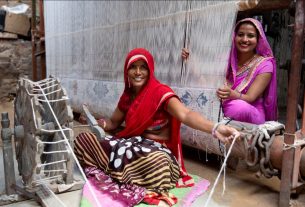
A critical but often overlooked dimension of the cultural significance of Rajasthani crafts is the role women have played as primary knowledge-holders. Embroidery and tie-dye techniques were passed through female lineages, taught mother to daughter across generations, with the woman's skill level directly influencing her social standing within the community. Academic research on craft communities has only recently begun to document this contribution properly (Social Research Foundation).
Recent coverage in AFAR Magazine (April 2026) highlighted women-led cooperatives in rural Rajasthan actively reviving endangered Kashida embroidery from Barmer by connecting directly with global buyers and bypassing traditional middlemen. This structural shift is significant for anyone who wants to purchase ethically.
Rajasthani Textile Art for Home Decor: What Works and What Doesn't
Used well, these textiles can anchor an entire room. Used carelessly, they read as costume rather than considered design. Here is the honest assessment.
Block-printed cotton makes exceptional table linen, bedding, and curtains. The repeat patterns scale up without overwhelming a space, and natural-dye versions age gracefully, softening rather than fading. A single large embroidered panel, framed or used as a wall hanging, creates a focal point that requires nothing else to compete with it.
Kota Doria is genuinely underused in home decor outside India. As a curtain fabric, it filters light in a way that heavier textiles cannot, and the subtle check pattern reads as refined rather than overtly ethnic in most contemporary interiors.
Two things to avoid: layering multiple embroidery traditions in the same room creates visual noise rather than richness. Bandhani and zardozi in the same palette will fight each other. Pick one dominant technique and let the others play supporting roles.
For practical guidance on mixing Rajasthani textiles with broader Indian decor elements, the deep dive at Jaipur Stuff's guide to Jaipur fabrics and textiles covers fabric-specific care and styling in useful detail.
What Is Shifting in 2026: Three Trends Worth Watching
The craft landscape in Rajasthan is changing faster than at any point in living memory.
Natural dyes are back as a premium signal. Synthetic dyes dominated through the 1990s and 2000s because they were cheaper and more color-consistent. Now, natural indigo, pomegranate, and madder-dyed textiles command significant price premiums, particularly in European and North American export markets where conscious purchasing is driving demand.
Artisan co-creation with global designers is producing genuinely new work. Rather than copying heritage patterns for mass production, several Jaipur workshops now collaborate directly with international designers who contribute new forms while artisans contribute technique. The resulting pieces are neither purely traditional nor purely contemporary. They are new objects with deep roots, and publications like Condé Nast Traveller India have taken notice in early 2026 coverage.
The export ambition is significant. The EPCH's 2024 handicraft roadmap sets an explicit target of tripling Rajasthan's handicraft exports, with textiles identified as the lead growth sector. That ambition is creating investment in quality control, artisan training, and international marketing that directly benefits buyers through more consistent sourcing and better provenance documentation (EPCH, 2024).
Where to Buy Authentic Rajasthani Textiles: The Tests That Matter
Authentic pieces require a buyer's eye. These are the checks that reveal the real thing.
For block prints: Look at the reverse side of the fabric. Hand-blocked prints show a faint bleed-through because the dye penetrates under the pressure of the wooden block. Machine prints are sharp on the face and blank on the reverse. Slight misalignments between repeat motifs are also a positive sign.
For bandhani: Unfinished knot marks on the reverse indicate genuine hand-tying. Industrial simulations print the dots onto the surface. Turn the cloth over; if the dots disappear, it is not real bandhani.
For Kota Doria: Ask for GI certification or purchase from a retailer with documented artisan relationships. The weight should feel almost impossibly light. If it feels like ordinary cotton shirting, it is not authentic Kota Doria.
For embroidery: Hand embroidery shows slight tension variations. Each stitch carries the idiosyncratic pressure of a human hand. Machine embroidery is perfectly uniform. Imperfection here is the quality indicator, not a flaw.
Shopping in Jaipur directly, specifically in the lanes around Johari Bazaar and at government emporiums like Rajasthali, gives the best access to verified authentic pieces. For buyers outside India, the right choice is a platform that partners directly with artisan cooperatives and provides craft provenance. Jaipur Stuff's handicrafts collection is curated specifically from artisan-verified Jaipur sources, making it a reliable starting point for both new collectors and experienced buyers.
Key Takeaways
- Rajasthani textile crafts include block printing (Sanganeri and Bagru), bandhani, leheriya, dabu mud-resist printing, Kota Doria weaving, and multiple regional embroidery traditions. Each is distinct in method, region, and visual character.
- Color and pattern were historically coded systems, not decoration. They communicated identity, status, and occasion in ways still legible in Rajasthan today.
- Kota Doria holds a GI tag; counterfeits are widespread. Weight and GI certification are the key authenticity markers.
- Natural-dye textiles command export premiums in 2026, and women-led cooperatives are reshaping how rural embroidery traditions reach global buyers.
- Hand-blocked prints show bleed-through on the reverse. Hand-tied bandhani shows knot marks. Hand embroidery has visible tension variation. These are the practical tests that matter when buying.
- The EPCH's strategic roadmap targets tripling Rajasthani handicraft exports, making quality infrastructure and artisan training a government-level priority.
- In home decor, one dominant technique per room is the rule. Layering multiple embroidery styles creates visual competition rather than depth.
Frequently Asked Questions
What are the main types of Rajasthani textile crafts?
Rajasthani textile crafts fall into four broad categories: hand block printing (Sanganeri and Bagru styles), resist dyeing (bandhani, leheriya, and dabu), handloom weaving (most notably Kota Doria), and embroidery (including gota patti, zardozi, and Kashida mirror work). Each category contains multiple regional sub-traditions with distinct techniques and visual languages.
What makes Bandhani different from Leheriya?
Bandhani creates a field of tiny resist-dyed dots by individually tying thousands of small points across the cloth before dyeing. Leheriya creates diagonal stripe patterns by rolling the fabric around a stick before tying and dipping in dye. Both are tie-dye techniques, but they produce completely different visual results and carry different cultural associations.
What is Kota Doria fabric and why is it special?
Kota Doria is a handwoven fabric made on traditional looms in Kota district using alternating cotton and silk threads in a distinctive square-check pattern called khats. The result is one of the lightest woven textiles in India, with a subtle translucency and exceptional drape. A GI tag means only registered weavers in Kota district can legally produce it under that name.
How can I tell if a block-printed textile is genuinely hand-printed?
Turn the fabric over. Genuine hand block prints show a faint bleed-through on the reverse because the dye penetrates the cloth under pressure from the carved wooden block. Machine or screen-printed imitations are sharp on the front and show no pattern on the reverse. Slight misalignments between repeat motifs are also a reliable positive indicator.
Which embroidery style is most iconic to Jaipur specifically?
Gota Patti is Jaipur's signature embroidery tradition. It applies narrow ribbons of zari metal fabric in dimensional floral and geometric shapes onto a base cloth. Originally developed for Rajput bridal wear, it is now widely used in contemporary fashion and remains the most recognizable visual marker of Jaipur's craft identity.
Are Rajasthani textiles suitable for home decor outside India?
Absolutely. Block-printed cotton works exceptionally well as curtain fabric, bedding, and table linen in any interior. Kota Doria makes a refined, light-filtering window treatment. Single embroidered panels used as wall art integrate easily into minimalist spaces. The practical rule is to choose one dominant technique per room rather than layering several simultaneously.
Where can I buy authentic Rajasthani textiles online?
Look for retailers who document artisan partnerships, provide GI certifications for relevant products, and offer natural-dye options with clear provenance. Buying from curated platforms that work directly with Jaipur artisan communities is the most reliable route to genuine pieces. Jaipurstuff.com sources from verified Jaipur craftspeople and offers a curated selection of traditional textiles and handcrafted goods.
What is Dabu printing?
Dabu is a mud-resist printing technique practiced primarily in Bagru near Jaipur. Artisans apply a thick paste made from clay, lime, and wheat chaff to selected areas of cloth using carved wooden blocks. The paste resists the dye bath, leaving those areas undyed. Once the mud cracks away after drying, it reveals a two-tone or multi-tone pattern with a distinctively soft, matte finish that no digital process can replicate.
Ready to bring the craft of Rajasthan into your home or wardrobe? Browse Jaipur Stuff's curated collection of authentic Rajasthani textiles and handcrafted items and discover pieces made by real artisans from the Pink City.